

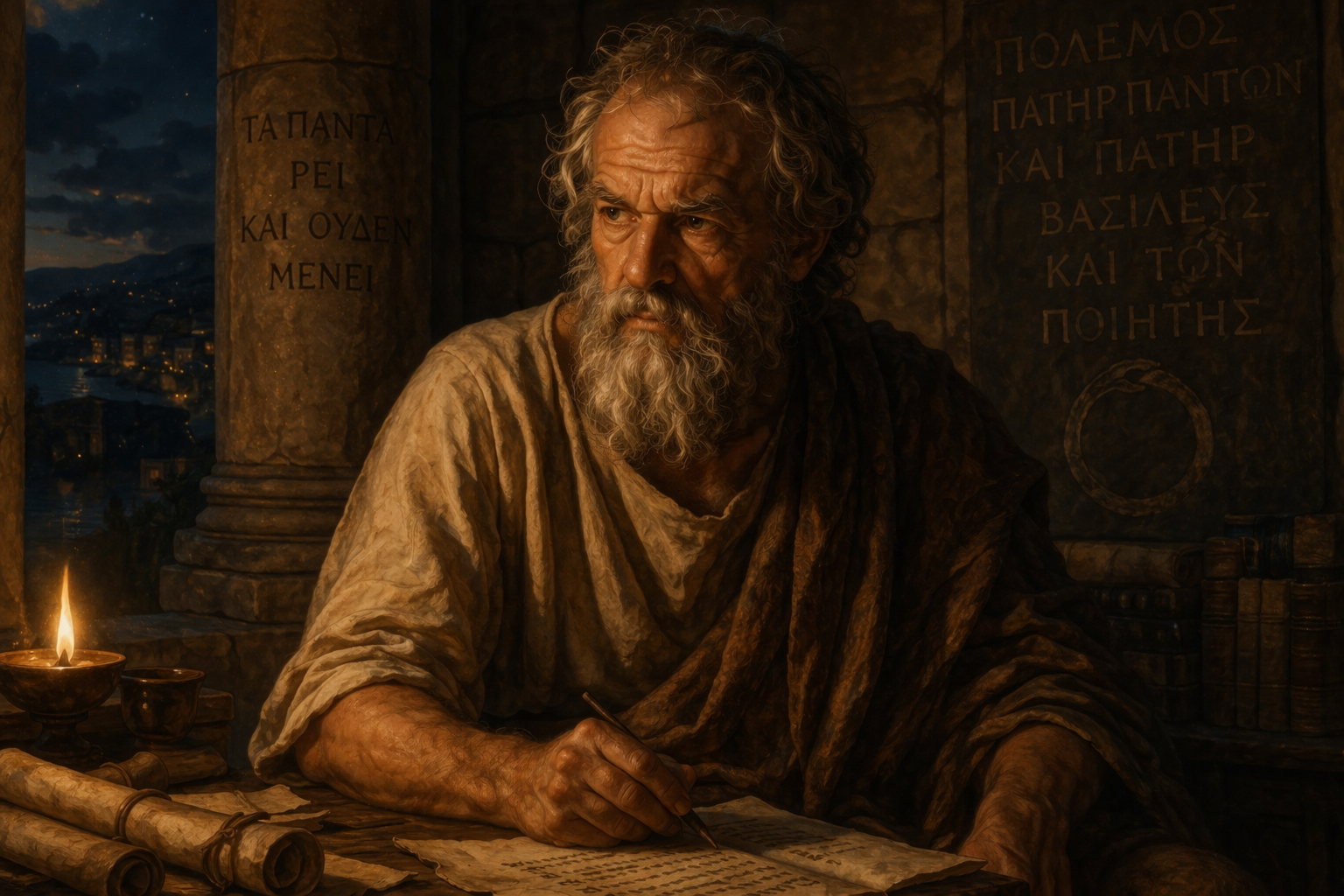
Heraclitus: The Philosopher of Perpetual Change and Forgotten Wisdom
2,500 years after his thought, the criticism of superficiality resonates strongly in the Spain of 2026.
In the crucible of Ancient Greece, where ideas forged the foundations of our Western civilization, the figure of Heraclitus of Ephesus emerges as a beacon of wisdom, often shrouded in mystery. Born into a noble family in the 5th century BC, Heraclitus, far from embracing power and luxury, chose the path of disseminating knowledge, imparting it with a simplicity that contrasted with the depth of his thought.
His masterpiece, 'On Nature', left us an enigmatic style, a tapestry of phrases that invited reflection but defied immediate understanding. He is not a philosopher for the casual reader; Deciphering the entirety of his worldview is a task that still challenges us today, revealing the complexity of his legacy.
Although the original work was lost in the mists of time, fragments of his thought have survived, recorded in quotes that continue to resonate. One of the most famous, “eyes and ears are bad witnesses for men who have barbaric souls,” confronts us with the nature of perception and judgment.
Heraclitus recognized the importance of our senses, eyes and ears, as portals to reality. However, his criticism targeted those who, armed with superficial information, dared to make judgments without deep understanding. Observation, for Heraclitus, had to go hand in hand with reflection.
To truly apprehend what we see and hear, the philosopher emphasized the need for reason, accumulated experience, and well-formed critical thinking. Unfortunately, he perceived a shortage of these qualities in large sectors of the society of his time, a lack that, according to him, prevented genuine understanding.
It is crucial to understand that, when referring to “barbarian souls,” Heraclitus was not alluding to intrinsic evil. His concept of “barbarian” extended to foreigners, those who spoke different languages and had foreign cultures. For him, this cultural otherness implied a disconnection with the 'logos', the rational principle and deep thought that he considered essential.
The inability to understand the 'logos' entailed, in the Heraclitean vision, an insurmountable barrier to apprehending the rational order that governs the universe. He was one of the pioneers in trying to separate the explanation of natural phenomena from mythological stories, seeking instead answers anchored in observation and reason.
Today, in the year 2026more than 2,500 years after his time, the essence of his criticism resonates with astonishing relevance. Despite technological advances and globalization, the tendency to express opinions without understanding the context, causalities or intrinsic nature of events persists. Superficiality, it seems, is a human condition that transcends time.
In the sports field, for example, we observe how public opinion, often based on immediate results or eye-catching headlines, ignores the complexity of strategies, the physical preparation of athletes or the circumstances surrounding a competition. The 'logos' of sport, that deep understanding of its dynamics, is sometimes overshadowed by the noise of immediacy.
Heraclitus's philosophy invites us to constant introspection. It challenges us to not be mere passive recipients of information, but to become active agents of our own understanding. The key lies in cultivating that “soul” that is not barbaric, the one that dares to question, investigate and seek the truth beyond appearances.
His legacy, although fragmented, offers us an invaluable tool to navigate the complexity of today's world. In an era of overinformation, the ability to discern, to apply critical thinking and to search for the 'logos' in each phenomenon becomes not only a virtue, but a necessity for an informed and reflective citizenry.
The river of life, as Heraclitus well knew, flows incessantly. And our understanding of it must be equally fluid, adaptable and deep. The invitation is open: are we willing to immerse ourselves in the waters of reflection and genuine knowledge?
Frequently Asked Questions about Heraclitus and his Thought
- Who was Heraclitus of Ephesus?
- Heraclitus was a Greek pre-Socratic philosopher who lived in the 5th century BC, known for his work 'On Nature' and his philosophy of constant change.
- What was the main work of Heraclitus?
- His main work was titled 'On Nature', although only fragments and quotes from it survive.
- What does the phrase “eyes and ears are bad witnesses for men who have barbaric souls” mean?
- Heraclitus criticized those who give opinions without really understanding what they see or hear, suggesting that reason and experience are needed for valid perception.
- What did Heraclitus mean by “barbarian souls”?
- He was not referring to malicious people, but to foreigners or those who did not share the deep Greek thought, the 'logos'.
- Why did Heraclitus believe that it was impossible for “barbarians” to understand the rational order of the universe?
- Because by not understanding the 'logos', it was difficult for them to grasp rational explanations of natural phenomena, separate from mythology.
- What is the relevance of Heraclitus today?
- His criticism of superficiality and the importance of critical thinking remain very relevant in our current information-saturated society.
- What is the 'logos' according to Heraclitus?
- The 'logos' for Heraclitus represented the universal rational principle, the law that governs the cosmos and deep thought.
- How does Heraclitus's thought compare to the society of 2026?
- Despite the advances, the tendency to give opinions without deep knowledge of the contexts and causalities persists, making its criticism still relevant.
- What does Heraclitus teach us about perception?
- It teaches us that sensory perception must be complemented by reason, experience and critical thinking to be truly useful.
- Where can I find more information about ancient philosophy?
- To delve deeper into these topics and discover more about ancient philosophy, we invite you to join our community on Telegram: https://t.me/casino_gurus
https://casinos-guru.com/heraclito-el-filosofo-del-cambio-perpetuo-y-la-sabiduria-olvidada/