

Selectivity: The controversial “parade” of a teacher that divides Spain
A teacher's demand to turn off cell phones before an exam sparks a debate on social networks about authority and education in the classroom.
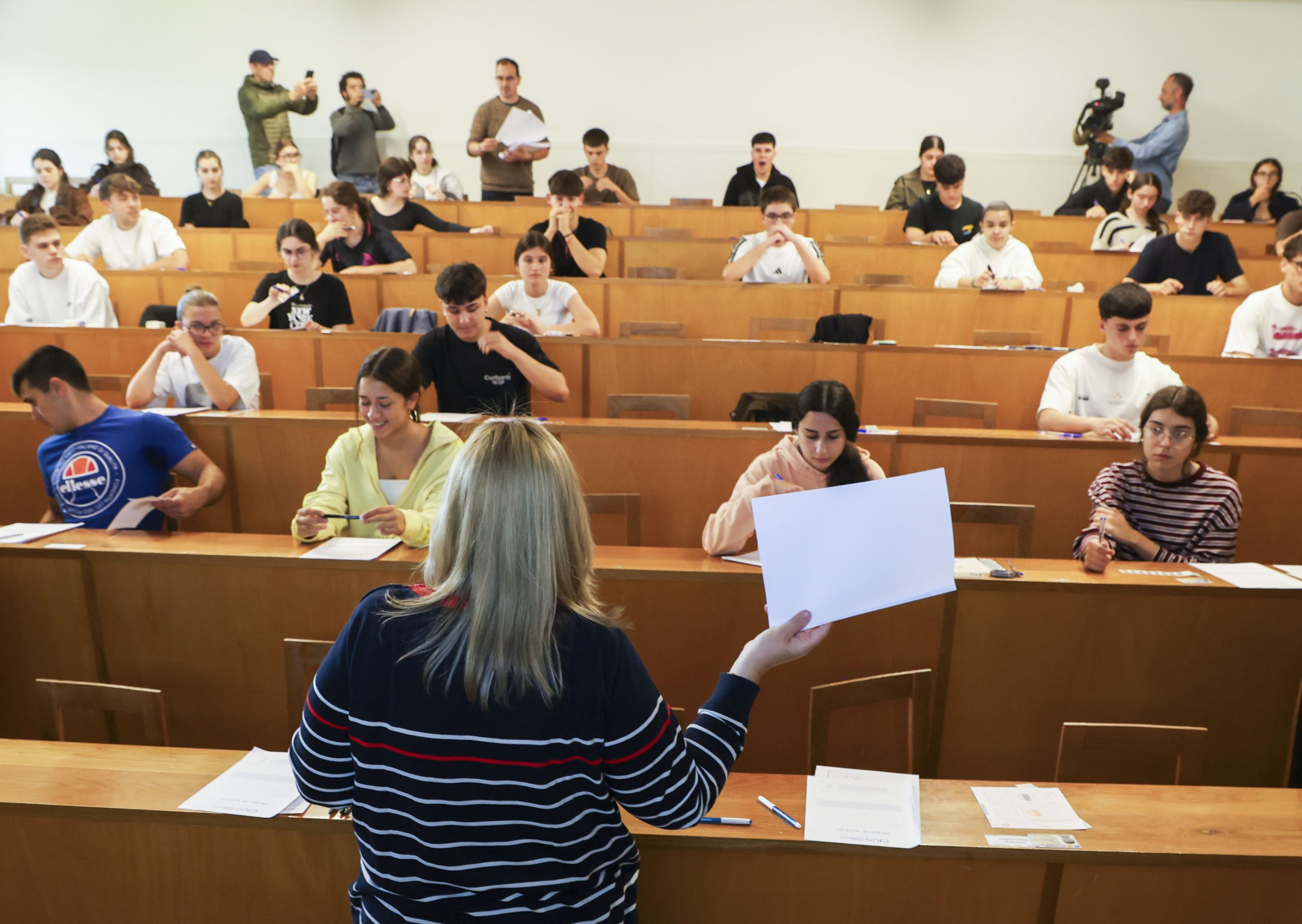
The selectivitythat rite of passage that marks the academic future of thousands of young Spaniards, has started with a unexpected focus of controversy. Beyond the mathematical formulas or literary analyses, attention has focused on a video that has lit up the networks, starring a teacher and her students in the moments before a crucial test.
The video, broadcast by the Murcia media 'La Verdad', shows a scene that is repeated in countless classrooms throughout Spain: the mobile phone review. The teacher, with the firmness that the moment demands, urges the students to make sure that their devices are completely turned off. However, the tone and words used have been the trigger for a wave of criticism.
The controversy soon spread to the networks, where the comments were divided between those who defended the teacher's actions and those who harshly criticized her for what they considered a lack of respect. Faced with this barrage of opinions, another teacher, known on networks as @laurimathteacherdecided to come forward to defend his colleague.
“I've seen the video and, honestly, it hasn't caught my attention. But when I got into the comments, I found criticism like 'Parading? What a lack of education!'” explained Professor Laura, visibly surprised by the reaction. For her, the teacher was simply remembering the rules with the necessary authority.
“They have been told all year that their cell phones must be turned off. And seeing how many get up to check it, it is evident that a firm reminder is necessary,” he argued. Laura insisted that it was not a lack of respect, but rather a way of being “forceful” and saying things “clearly.”
The teacher argued that there is nothing wrong with being direct with students, especially in an exam context. “He is not disrespecting them, he is not insulting them. He is simply saying things clearly,” he stressed. He added that the expression “parading” was even considered a “nice” way of expressing oneself, a simple “way of speaking.”
Laura regretted “thin skin” which, in his opinion, many have when faced with this type of situation. “I understand that they are very nervous about the exam, but what I see is a teacher remembering the rules. And when talking about rules, you have to be serious and forceful,” he insisted.
The teacher went further, comparing the situation with the world of work. “These kids then go to work, the boss comes, tells them four things and they break down. You can't tell them anything,” he said. For her, the fragility of some people in the face of a simple indication is worrying.
“What's wrong? You can't tell them anything? My blood boils with the fragility that people have. You can't tell them anything. You should care more about other things and not about a teacher saying to her students 'come on, parade'. I haven't said it myself sometimes, and they've laughed,” Laura concluded, defending the need for an education that prepares young people to face life with greater resilience.
This incident, although it may seem minor, highlights the latent tension between new generations and traditional forms of authority. Selectivity, beyond being an academic test, has become a mirror of the social and educational dynamics of our time.
The way in which norms and expectations are communicated, especially in high-pressure environments such as exams, is a topic worthy of reflection. Should the forms be adapted to the sensitivity of young people, or is it necessary for them to get used to more direct and forceful language to prepare for future challenges?
The debate is served, and social networks, as always, are the perfect setting for society to express its opinions and seek consensus, or at least, mutual understanding.
Frequently Asked Questions about Selectivity and the Controversy
- What are the University Access Tests (PAU)?
- They are exams that high school students must pass in order to access university.
- Why has controversy been generated around a selectivity video?
- The controversy arises from the way in which a teacher instructed her students to turn off their mobile phones before an exam, which some considered disrespectful.
- What was teacher @laurimathteacher defending?
- He defended his colleague's actions, arguing that he was being firm and clear in remembering the rules, something necessary in an exam.
- What criticism did the teacher of the video receive?
- The criticism focused on its tone and the words used, considering them uneducational and disrespectful towards the students.
- What argument did @laurimathteacher use to defend the teacher?
- He argued that it was necessary to be forceful to remember the rules and that the expression “parading” was a figure of speech, not disrespect.
- What role do social networks play in these events?
- Social networks are key for the dissemination of these videos and for public debate, polarizing opinions and generating discussion.
- Is it common for there to be controversies related to selectivity?
- Yes, every year debates arise about different aspects of selectivity, from the difficulty of the exams to the organization or the interactions between teachers and students.
- What is expected from the selectivity exams in 2026?
- It is expected that they will continue to be a fundamental test for access to higher education, with possible adjustments in the format or syllabus according to educational guidelines.
- How does the pressure of selectivity affect students?
- The pressure is high, since access to the desired career depends on these exams, which can generate nervousness and stress.
- Where can I find more information and join discussions on similar topics?
- We invite you to join our community on Telegram to follow the discussions and learn more: https://t.me/casino_gurus
https://casinos-guru.com/selectividad-el-polemico-desfile-de-una-profesora-que-divide-a-espana/










 Pronóstico Deportivo: Džiugas Telšiai vs. Banga...
 Pronóstico: Celje vs Koper – 16 de mayo d...
 Pronóstico Deportivo: Diósgyőr vs Paksi –...
 Pronóstico Deportivo: Conner Huertas vs. Ignaci...
 Final en Roma: Coco Gauff vs. Elina Svitolina &...
 Pronóstico del partido: Italia vs. Canadá ̵...
 Pronóstico del partido Chelsea vs Manchester Ci...
 Pronóstico para el partido Madison Keys vs. Yul...
 Pronóstico Deportivo: Tristan Boyer vs. Dali Bl...