

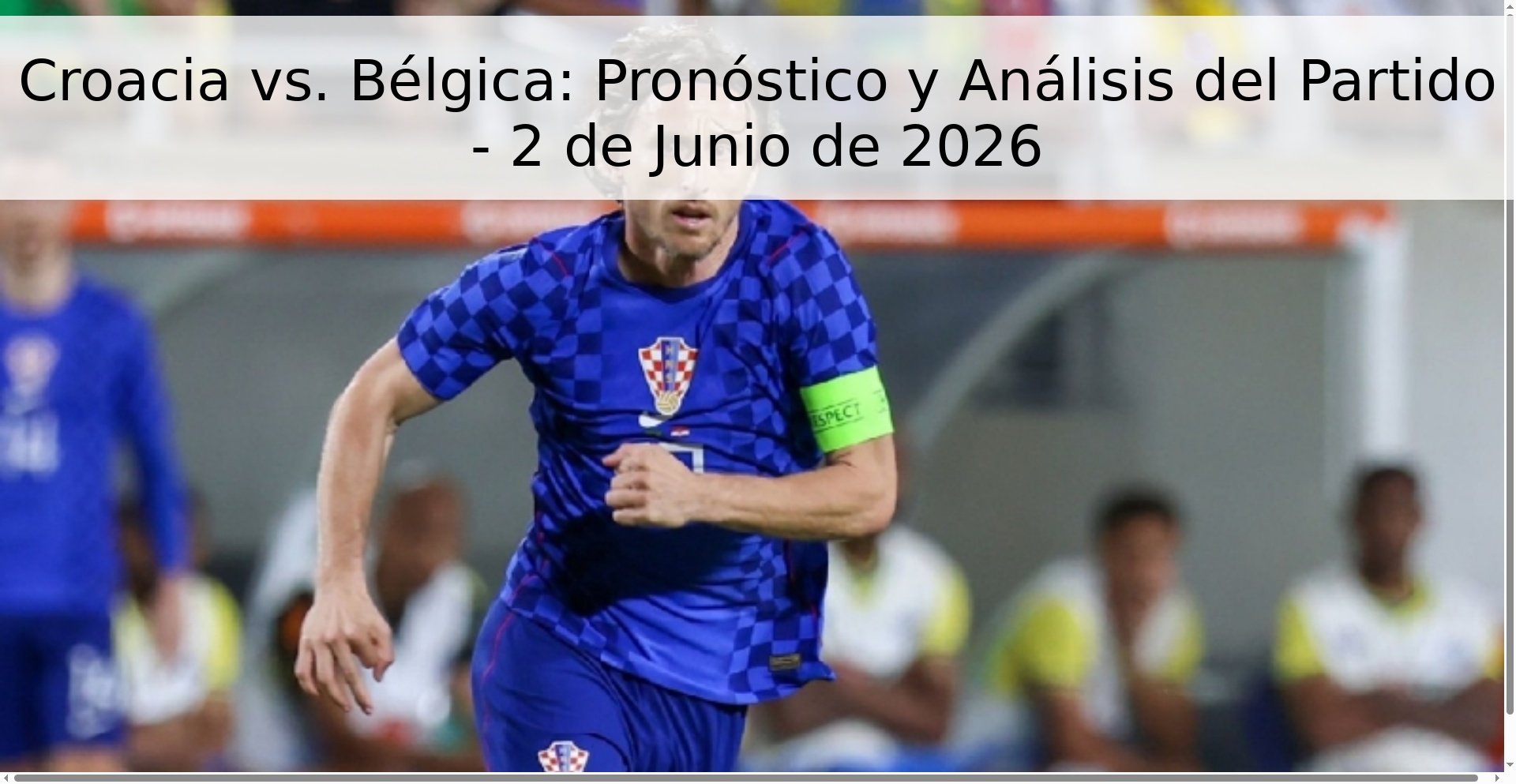
Croatia vs. Belgium: Match Forecast and Analysis – June 2, 2026
Prediction: Draw with Goals. Main Bet: Both teams score.
On June 2, 2026, the Croatian national team will face Belgium in an international friendly that promises to be a tactical and exciting duel. Both teams arrive with different trajectories in their last participations, but with the firm intention of measuring their strength for future commitments.
The last meeting between these two teams took place in the group stage of the World Cup in Qatar, where the result was a goalless draw (0-0). This previous statistic gives us a clue of the parity that usually exists between both teams, although the context of a friendly can vary the dynamics.
We will take an in-depth look at current form, recent statistics and the key factors that could influence the outcome of this exciting encounter.
Analysis of Croatia
The Croatian team demonstrated its solidity by achieving its place in the World Cup without major setbacks. In their qualifying group, they accumulated 22 of a possible 24 points, without knowing defeat and leading with a considerable advantage over their pursuers.
Their only setback in the qualifying phase was an away draw against the Czech Republic (0-0). After securing their World Cup berth, they played two friendly matches, achieving a victory against Colombia and suffering a defeat against Brazil (1-3).
Croatia maintains its usual strength in its field, where it has not lost since 2023. This unbeaten streak at home is a factor to take into account for this confrontation.
Croatia's last 5 games:
- Brazil 3 – 1 Croatia (Friendly)
- Colombia 1 – 2 Croatia (Friendly)
- Montenegro 2 – 3 Croatia (World Classification)
- Croatia 3 – 1 Faroe Islands (World Qualification)
- Croatia 3 – 0 Gibraltar (World Classification)
Croatia Key Statistics:
- Shape: 8/10
- Stroke: 7/10
- Defense: 7/10
- Motivation: 8/10
Betting Trends for Croatia:
- In seven of their last ten games, more than three offsides have been recorded.
- In four consecutive games, both teams have managed to score.
Possible Croatia Lineup:
Livaković – Vušković, Ćaleta-Car, Gvardiol – Stanišić, Vlašić, Kovačić, P. Sučić, Perišić – Matanović, Baturina.
Analysis of Belgium
Belgium found itself in a relatively accessible World Cup qualifying group, sharing a zone with Wales, North Macedonia, Kazakhstan and Liechtenstein. Despite not facing major difficulties in leading the group, they only led Wales by two points and had three draws in eight games.
After the qualifying phase, the team led by Rudi García played two friendly matches against the United States (5-2) and Mexico (1-1). In these matches, defensive problems were evident against moderate level opponents.
Belgium is going through a process of generational renewal. On the defensive line, the absence of key players such as Kompany, Vertonghen and Alderweireld has created some instability.
Belgium's last 5 games:
- Mexico 1 – 1 Belgium (Friendly)
- United States 2 – 5 Belgium (Friendly)
- Belgium 7 – 0 Liechtenstein (World Classification)
- Kazakhstan 1 – 1 Belgium (World Qualification)
- Wales 2 – 4 Belgium (World Classification)
Belgium Key Statistics:
- Shape: 6/10
- Stroke: 7/10
- Defense: 5/10
- Motivation: 7/10
Betting Trends for Belgium:
- In three of their last four games, Belgium has failed to win the first half.
- In eight of their ten previous matches, Belgian players have had more shots on goal than their rivals.
Possible Belgium Lineup:
Sels – Castagne, Debast, De Winter, De Keper – Onana, Tielemans – Saelemaekers, De Ketelaere, Doku – Ferndandez-Pardo.
Comparison of Teams and Statistics
Looking at the overall statistics, both teams show considerable offensive potential. Croatia has maintained slightly better ball possession in the last 20 games, while Belgium has averaged more shots on goal in the same period.
Regarding direct confrontations, the last official match ended in a 0-0 draw, suggesting tactical parity. However, in previous friendlies, Belgium achieved a narrow victory (1-0).
The table below summarizes some key statistics from both teams' last 20 games:
| Statistics | Croatia (Last 20 matches) | Belgium (Last 20 matches) |
|---|---|---|
| ball possession | 57.4% | 60% |
| Total shots | 14.9 | 14.7 |
| shots at door | 6.6 | 6.3 |
| Corners | 6.3 | 8.2 |
| Fouls committed | 10.9 | 10.1 |
| yellow cards | 1.8 | 1.8 |
Regarding scoring effectiveness, both teams have a high probability of scoring more than 0.5 goals in their matches. However, the number of matches with more than 2.5 goals is higher in Croatia, which could indicate more open matches on their part.
| Statistics | Croatia (Last 20 matches) | Belgium (Last 20 matches) |
|---|---|---|
| More than 0.5 goals | 95% | 90% |
| More than 1.5 goals | 80% | 75% |
| More than 2.5 goals | 65% | 55% |
| More than 3.5 goals | 45% | 45% |
| More than 4.5 goals | 25% | 30% |
| More than 5.5 goals | 20% | 30% |
In the last two direct confrontations, the goal average is low, with 0.5 goals for Croatia and 0 for Belgium. However, this is based on a very limited number of matches.
Analysis of Latest Matches and Direct Confrontations
The results table of the last matches shows that Croatia has had a more consistent performance in the qualifying phase, with important victories. Belgium, for its part, has shown a greater propensity for draws in its group, but has also scored a significant number of goals in recent friendlies.
The history of direct confrontations is limited, but the last official match in the World Cup in Qatar ended in a goalless draw. This suggests that both teams neutralize each other in high-tension matches.
In Croatia's last 5 games, there is a tendency to score and receive goals, with an average of 2.6 goals per game. Belgium, in its last 5 games, has also shown an average of 2.6 goals, but with greater variability in the results.
In Croatia's last 10 games, the goals average is 2.4, while for Belgium it is 2.6. This reinforces the idea that we could see a game with goals.
In the last 20 games, Croatia has averaged 2.2 goals per game, and Belgium 2.3. The difference is minimal, which underlines the parity between the two.
Recommended Betting Levels
Main Bet: Both teams score (BTTS)
Considering the offensive capacity of both teams and recent trends, the bet that both teams will score appears to be the most solid option. Croatia is usually a team that creates chances and Belgium, despite its defensive problems, has players capable of finishing plays.
Safe Bet: More than 1.5 goals
Since both teams have a history of scoring and conceding goals, betting on at least two goals in the match offers a good risk-reward ratio. It is unlikely that a match between these two teams will end 0-0, especially in a friendly context.
Risk Bet (High Odds): Draw and Both teams score (X and BTTS)
If we are looking for a higher odds, the combination of a draw with goals could be interesting. The last direct confrontation ended in a draw, and the parity that usually exists between both teams, added to their offensive potential, makes this option plausible.
Frequently Asked Questions (FAQ)
How is this forecast made?
This forecast is prepared through an exhaustive analysis of statistical data from platforms such as Flashscore, Sofascore and Whoscored. Factors such as recent team form, home and away performance, head-to-head matches, goal statistics, betting trends and information on withdrawals and possible lineups are considered.
Why is this result predicted?
The prediction is based on the combination of several factors: Croatia's defensive and offensive solidity, especially at home; Belgium's ability to create scoring chances despite its defensive weaknesses; and the history of head-to-head confrontations that often result in close matches. The tendency of both teams to score and concede goals in their last matches is a key indicator.
What will happen if the prediction does not come true?
In the world of sports, there are always unexpected variables. If the prediction does not come true, it is important to remember that sports betting carries risks. Factors such as early expulsions, individual errors or unforeseen tactical changes can alter the course of the match. In case of a failed prediction, it is recommended to analyze the causes and adjust the strategy for future bets, without falling into frustration.
What methodology is used for the analysis?
The methodology focuses on quantitative and qualitative analysis. Objective data on team performance is collected and complemented by a qualitative analysis of the current situation, such as motivation, pressure and importance of the match. Patterns and trends are sought that allow us to anticipate the most likely development of the meeting.
Why do you trust this prediction?
Confidence in this prediction is based on the rigor of data analysis and practical experience in interpreting sports statistics. The aim is to offer an objective and well-founded vision, minimizing subjectivity. Data consistency and the identification of clear trends are the cornerstones of this trust.
What unexpected variables could affect the outcome?
Several unexpected variables can influence the outcome: last-minute injuries to key players, controversial refereeing decisions, adverse weather conditions, or exceptional performance by a particular player. Luck also plays a role, as in any sporting event.
What is recommended if the prediction does not come true?
If the prediction does not come true, it is recommended to stay calm and not make impulsive decisions. It is important to learn from experience, review the analysis performed and consider what factors may have been underestimated. Bankroll management is essential, and you should never bet more than you can afford to lose.
How is team form evaluated?
Team form is assessed by analyzing the results of their last matches, the quality of opponents, consistency in performance and individual player statistics. The aim is to identify whether a team is on a positive or negative streak.
How important is motivation in prognosis?
Motivation is a crucial factor. A team with high motivation, whether due to an important objective, a historical rivalry or the need to vindicate itself, can overcome a theoretically superior rival. The importance of the match for each team is considered.
What do you do if a key team has significant casualties?
Information about significant casualties is essential. If a key player is absent, the impact that his absence will have on the team's performance, both in attack and defense, is evaluated. The aim is to determine if there are quality substitutes or if their absence significantly weakens the group.
https://casinos-guru.com/croacia-vs-belgica-pronostico-y-analisis-del-partido-2-de-junio-de-2026/